

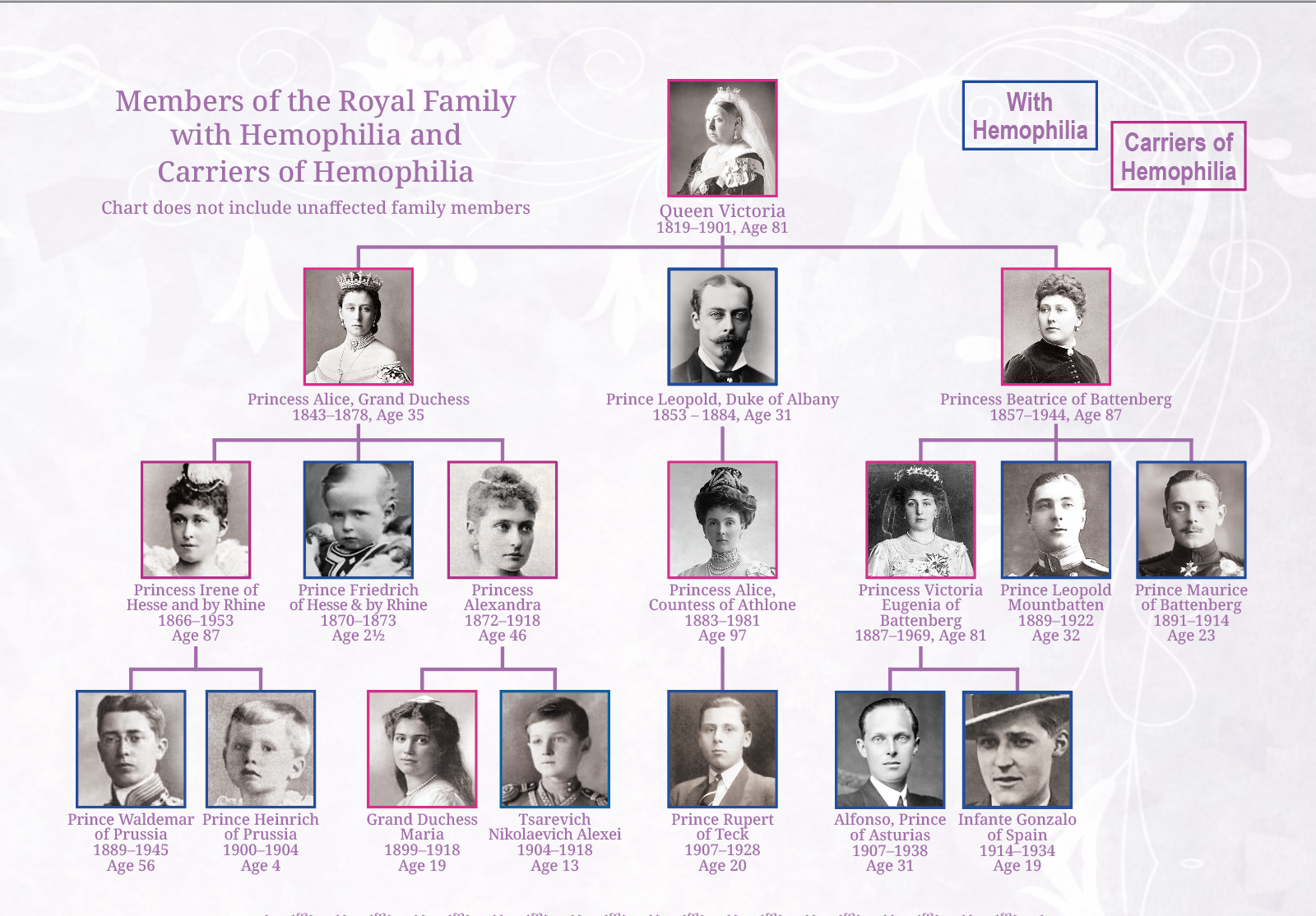
What is the royal disease? The royal disease name refers to hemophilia. This inherited disorder makes it hard for blood to clot, and DNA tests show that Queen Victoria’s family carried hemophilia B. People with this form have too little clotting factor IX.
The history of this royalty disease includes power and wealth, along with pain, secrecy, and loss. Doctors knew little about hemophilia at the time. They had no effective treatment, so even a small injury could be deadly.
Queen Victoria became the British monarch in 1837, at age 18. She ruled for more than 60 years, and her nine children and many of her 42 grandchildren married into royal families across Europe. This earned her the name “the Grandmother of Europe.”
Those marriages built political ties, but they also carried hemophilia into other royal families. Victoria had one son with hemophilia, and at least two of her daughters carried the gene change. Over time, the disorder appeared in Germany, Russia, and Spain.
Hemophilia is linked to the X chromosome. Anyone can have symptoms, but the disorder has often been more severe in males, and Victoria’s family did not know its exact genetic cause. Many relatives kept the illness private, and more than a century later, tests of the Romanov family’s DNA showed that they had hemophilia B.
This royal bleeding disease touched each family in a different way. In many cases, the loss was devastating.
Prince Leopold, Duke of Albany
Prince Leopold was Queen Victoria’s eighth child. He was the only one of her four sons known to have hemophilia. Victoria worried about his safety and urged him to stay close to home.
Leopold could not pursue a military career, but he studied at Christ Church, Oxford, and supported the arts and literature. He also helped his mother with her work, and despite her objections, he married Princess Helena of Waldeck and Pyrmont. They had two children, Alice and Charles Edward.
In 1884, Leopold fell and hurt his knee while in Cannes, France. He died the next morning at age 30, reportedly from bleeding in his brain, and his daughter Alice carried the gene change. She later passed it to her son, Prince Rupert of Teck.
Prince Rupert of Teck
Prince Rupert of Teck was Victoria’s great-grandson. He was later known as Rupert Cambridge, Viscount Trematon, and like his grandfather Leopold, he had hemophilia.
Rupert attended Eton and Trinity College, Cambridge, and in 1928 a car crash in France injured him. Reports called his skull fracture slight, yet he died from bleeding a few days later, at age 20.
People searching for Prince Maurice of Teck’s cause of death may mean Rupert. Maurice was Rupert’s younger brother, who died as an infant in 1910. Records do not clearly state why he died or confirm that he had hemophilia, while Rupert was the Teck prince known to have the disorder.
Neither brother should be confused with Prince Maurice of Battenberg. He was another grandson of Victoria and died from wounds in World War I.
The royal disease reached German and Prussian families through Victoria’s daughters Alice and Beatrice. Their children passed it to later generations.
Lord Leopold Mountbatten
Lord Leopold Mountbatten was the son of Princess Beatrice and Prince Henry of Battenberg. He served in the King’s Royal Rifle Corps and received royal honors.
Hemophilia caused repeated bleeding in his hip, and he died in 1922 after surgery on the joint, when he was 32 years old.
Prince Maurice of Battenberg
Leopold’s younger brother Maurice also served in the King’s Royal Rifle Corps. He died in battle at Ypres in 1914, at age 23, though sources differ on whether he had hemophilia.
Prince Friedrich of Hesse
Prince Friedrich, known as “Frittie,” was the son of Victoria’s daughter Alice. A small cut on his ear bled for several days and showed that he had hemophilia.
A few months later, Friedrich fell from a window. He survived the fall but died hours later from bleeding in his brain at age two.
Prince Waldemar of Prussia
Prince Waldemar was the son of Princess Irene of Hesse, a granddaughter of Victoria. He lived into his 50s, and by then blood transfusions could help treat serious bleeding.
Near the end of World War II in Europe, Waldemar and his wife fled the Russian advance. In Tutzing, Bavaria, he needed another transfusion, but blood and medical supplies were scarce, and the Prince Waldemar of Prussia cause of death was internal bleeding linked to hemophilia. He died in May 1945, at age 56.
Prince Heinrich of Prussia
Waldemar’s younger brother Heinrich also had hemophilia. At age four, he fell headfirst from a table. He died the next day from bleeding in his brain.
One of the best-known stories is that of Tsarevich Alexei Nikolaevich. He was the only son of Tsar Nicholas II and Empress Alexandra. Alexandra was Victoria’s granddaughter and carried hemophilia.
Tsarevich Alexei Nikolaevich
After four daughters, the Romanov family welcomed a son and heir. But soon after Alexei’s birth, his navel kept bleeding when doctors cut his umbilical cord.
As a child, Alexei had painful bleeds, and some threatened his life. His family limited his activities, and two sailors watched him to help prevent injuries. Even a small bump could mean weeks of pain and bed rest.
Alexandra and Nicholas turned to Grigori Rasputin for help. He seemed to calm Alexei during severe bleeds. Historians have suggested several reasons. His calm presence may have helped, and he also told doctors to stop some treatments that may have made the bleeding worse.
The family mostly kept Alexei’s illness secret, and their reliance on Rasputin raised public concern during a time of political unrest. After the Russian Revolution, the family was jailed and executed in July 1918.
Decades later, tests of Romanov DNA found a change in the F9 gene. This showed that Alexei had severe hemophilia B and answered a long-standing question about the royal disease.
Hemophilia reached Spain through Victoria’s granddaughter, Victoria Eugenie of Battenberg. She married King Alfonso XIII. Two of their sons, Alfonso and Gonzalo, had the disorder.
Alfonso, Prince of Asturias
Alfonso was the couple’s oldest son and heir to the throne. Doctors found his hemophilia after he was circumcised. He and Gonzalo wore special clothing meant to protect them from injury.
After Spain ended its monarchy in 1931, Alfonso gave up his claim to the throne to marry a commoner. In 1938, he was in a car crash in Miami. His injuries seemed minor at first, but internal bleeding took his life at age 31.
Infante Gonzalo of Spain
Gonzalo was the youngest child of Alfonso XIII and Victoria Eugenie. He studied engineering and served in the Spanish Army.
In 1934, Gonzalo and his sister were in a car crash in Austria. He seemed unhurt at first, but later he had severe bleeding in his abdomen. He died two days later, at age 19.
Victoria’s family shows how dangerous hemophilia was before modern care. A fall, surgery, or car crash could lead to fatal bleeding inside the body or brain.
Royal cases also drew more medical attention to hemophilia. In the late 1800s, more doctors wrote about it. They learned how families passed it down and how bleeding affected the body. Blood transfusions offered limited help in the 1900s. Later advances brought clotting factor replacement and treatments that help prevent bleeds, and today some eligible patients can also receive gene therapy.
Hemophilia affects people far beyond royal families and is a lifelong bleeding disorder. With expert care and a plan that fits their needs, many people with hemophilia lead active, full lives.
At LUX Infusion, our care team knows that managing a bleeding disorder takes planning. We work with patients, families, prescribing providers, Hemophilia Treatment Centers, and community groups. Our goal is to make care more personal and easier to manage.
Our care coordinators offer personal support and are available around the clock to help patients and families during treatment.
Learn more about LUX Infusion’s bleeding disorder services.
What is the royal disease?
The royal disease is hemophilia, an inherited disorder that makes it hard for blood to clot. DNA tests show that Victoria’s family carried hemophilia B, also called factor IX deficiency.
Why is hemophilia called the royal disease?
Victoria’s descendants carried hemophilia into royal families in Britain, Germany, Russia, and Spain, which gave it the name “the royal disease.”
Are there different royal diseases?
The phrase “royal diseases” can refer to many illnesses linked to royal families. In this story, “the royal disease” means hemophilia.
What was Prince Maurice of Teck’s cause of death?
Maurice died as an infant in 1910, and records do not clearly say why. People may confuse him with his brother Rupert, who had hemophilia and died after a car crash. Prince Maurice of Battenberg was a different relative. He died from wounds in World War I.
What was Prince Waldemar of Prussia’s cause of death?
Waldemar died from internal bleeding linked to hemophilia in 1945. Wartime shortages kept him from getting a needed blood transfusion.
LUX Infusion is elevating infusions into an experience. As a U.S.-based, clinician-led infusion services company, we provide both home infusion and ambulatory infusion center services, bringing clarity, compassion, and expertise to every patient relationship. With faster therapy starts, dedicated patient support, and continuous data sharing with providers, LUX Infusion ensures patients feel supported, and providers and partners can trust in better adherence and outcomes. For more information, visit luxinfusion.com.
If you or a patient you care for is managing a bleeding disorder and looking for an infusion care partner who understands that care extends beyond treatment, we are here. Referring providers can submit a referral on our website. A welcome call goes out within four hours. If you’re a patient, click here.
Disclaimer: This content is for informational purposes only and is not intended to serve as a substitute for the consultation, diagnosis, and/or medical treatment of a qualified physician or healthcare provider, or as legal advice. Please consult a physician or other healthcare professional for your specific health care and/or medical needs or concerns and never disregard professional medical advice or delay in seeking it because of something you have read here or on our website.
References