

On our first date, he shared that he had hemophilia. Having faced my own health challenges, I wasn’t particularly concerned. A few months later, we were living together and planning our wedding. Our daughter, Stephanie, was born about a year after we married. Life was on a steady track, but that didn’t last long.
In early 1985, during an appointment at the hemophilia treatment center, my husband was asked to participate in a CDC study on blood transfusion safety, which included our daughter and me. We had never received a transfusion, but he assured me it was standard practice. After blood samples and personal questions, we were supposed to receive follow-ups, but we never heard back.
Curious, I reached out in December and was asked to bring my family in for an appointment the following day. There, we learned the blood supply had been tainted with HIV, and both Michael and I had tested positive, our daughter was negative. While there was uncertainty about whether she would remain negative, it offered us a small glimmer of hope. The prognosis for Michael and I was grim; most people with the virus died within 18 months to two years. We were advised to keep this information quiet due to the stigma and fear surrounding the new virus.
To say the devastating news changed our lives would be an understatement, but we persevered as best we could. With little information about HIV available, we tried our best to educate ourselves while keeping our situation secret. Over the next years, national news stories about violence against HIV-affected families caused me great concern, but Michael was reluctant to discuss it. One thing was sure: it wasn’t the time to be openly public about being infected.
In 1989, to find a supportive outlet to speak openly and discuss our concerns and fears, I co-founded a women’s group within the local bleeding disorder community. A social worker helped connect me with another spouse of a man with hemophilia and HIV. With the support of the HTC and the local hemophilia chapter, we gathered over 25 women at our first meeting, creating a safe space to discuss our fears about HIV alongside issues like grief, stigma, and practical matters such as health insurance.
In 1990, I began working as an educator at a local AIDS prevention agency, speaking in various settings to raise awareness. This role was invaluable, allowing me to inform others while also giving me the opportunity to learn more about my condition in a supportive environment without fear of reprisal. During this time, my husband began facing serious health issues that required medical attention and many doctor visits. Although he had initially opposed my starting a support group for women, he eventually recognized the importance and began hosting men’s groups at his workplace, which became highly supportive once they learned of our situation. Tragically, he passed away from HIV-related lymphoma in October 1992 at just 33 years old.
Our daughter, Stephanie, was eight when Michael passed away. Though we initially kept our illness from her, as she grew older, she began asking questions. Although she was young, she understood that I was also suffering from HIV-related health issues. We felt it was better to be honest with her, which led to her developing separation anxiety and fear of losing us. She experienced behavioral and academic issues at school due to stigma, and struggled with anorexia. Though she never contracted HIV, with her father’s passing and the uncertainty of my health, Stephanie bore the heaviest burden.
By 1999, AIDS had become a widespread topic in the news, instilling fear in many. It had decimated the hemophilia community. My colleague, Candice Moench, and I decided to create workshops for girls and women with HIV. We wanted to create an engaging and artistic way to reach affected women and provide them a safe space to share their stories. This led to the Stitches Doll Project, aimed at helping women cope with their diagnoses while raising awareness in the broader community about HIV.
The doll forms are customized by the women with fabric, buttons, markers, ribbon, and all kinds of embellishments. We ask, “If your doll could talk, what would she say?” The responses are powerful and moving. This simple project quickly gained recognition through news stories and articles in POZ and A&U magazines, two publications dedicated to HIV/AIDS issues.
Initially, we were able to purchase dolls through our organization. However, when I left my job at the AIDS prevention agency, I continued the project from my basement with the support of my second husband, Bill, my mom, and my sister. For years, my dear hemophilia community friend, Jackie Lucas, sewed and donated all the doll forms, while others contributed ribbon, fabric, buttons, and beads. Today, we raise funds locally to purchase the doll forms.
A couple of years later at a workshop with the bleeding disorders community, a friend suggested expanding the project’s mission to include women with bleeding disorders. I immediately agreed, leading to our next collection named the ClotNot Club.
This evolution garnered great attention through our community, allowing me to host workshops at local, regional, and national events and showcase completed dolls. With funding secured, we traveled to various meetings and hemophilia camps across several states to work with young girls affected by a bleeding disorder and the sisters of affected boys.
Through social media, I connected with others interested in the project, ultimately leading to an invitation in 2014 to India’s first educational workshop for women with bleeding disorders. Over two transformative weeks, we provided vital information and support, introducing doll-making as a way to empower women in New Delhi and Puri. We provided essential information about bleeding disorders, discussed ways to earn income from home while caring for their affected children, and supported their psycho-social needs through doll-making. During my trip, I met Fatima, a hemophilia mom from Iran, who later replicated our efforts there, and Andrea from the Philippines, who did the same.
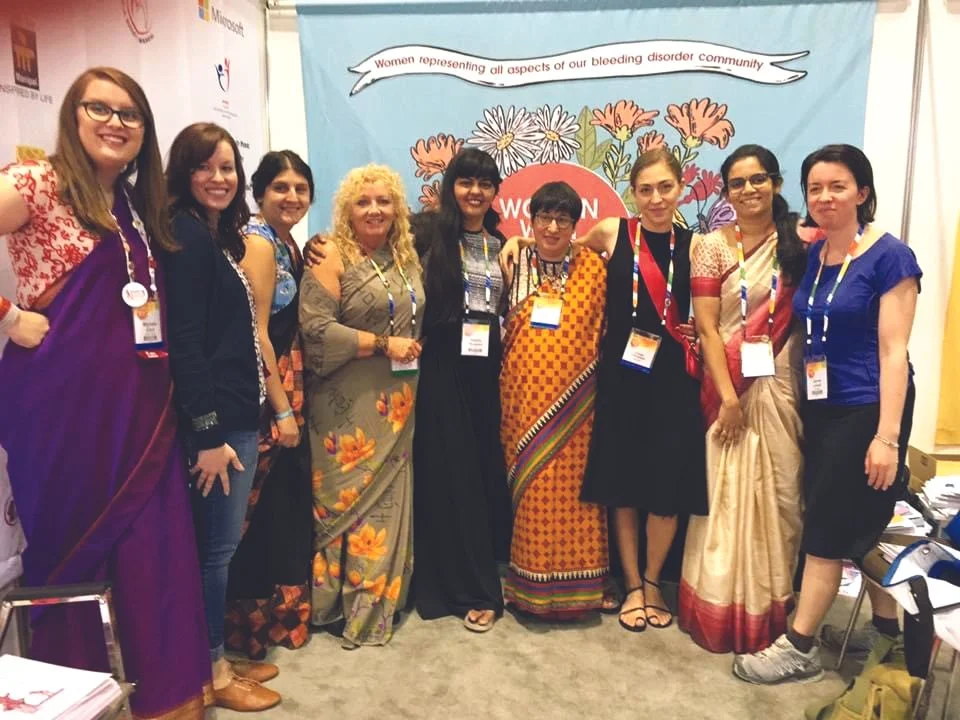
These international connections inspired a women’s booth at the 2016 World Federation of Hemophilia (WHF) Global Summit in Orlando, Florida, marking the first time women had a dedicated space in the exhibit hall of a global meeting. Our project expanded further at the 2018 WFH conference in Scotland, where we offered quilt square making alongside doll workshops. Stitches dolls created by women globally are now part of a traveling exhibit, and the project continues to grow through local fundraising and volunteer dedication. The dolls and their poignant stories can be viewed on our website, the Stitches Doll Project: http://stitchesdollproject.org/.
The doll project has been incredibly successful and continues to operate independently, relying on donations of supplies and the unwavering support of individuals who recognize its importance to our community. Over time, the project has expanded to address other areas of concern for women, including survivors of hemophilia, HIV/AIDS, sexual and domestic abuse, at-risk youth, transgender discrimination, and orphans, preserving the invaluable stories of girls and women.
As I reflect on the tumultuous journey we’ve traveled, I am reminded of the strength that can arise from vulnerability and the importance of community in times of crisis. The challenges we’ve faced have shaped us in ways I could never have anticipated. Though the shadows of loss and fear remain, they are accompanied by the warmth of support and love that has fortified our spirits.
Stephanie and I continue to honor Michael’s memory, finding solace in the truth that, while his absence is deeply felt, our bond as a family has emerged even stronger. Together, we carry on, advocating for awareness, acceptance, and hope—turning our trials into lessons and our fears into bridges toward a brighter future.
Kathleen Gerus-Darbison holds a Bachelor’s degree in Psychology and a Master’s degree in Sociology. She is a professor of Sociology at Macomb Community College in Warren, Michigan. She remarried in 1998 and lives near Detroit with her husband, Bill.
Believe Ltd.’s most recent film, “On The Shoulders of Giants” showcases the Stitches Doll Program and highlights the importance of women’s voices. To view the film, visit:
DISCLAIMER: THIS IS NOT MEDICAL OR LEGAL ADVICE. All information, content, and material is for informational purposes only and is not intended to serve as a substitute for the consultation, diagnosis, and/or medical treatment of a qualified physician or healthcare provider or as legal advice. Please consult a physician or other health care professional for your specific health care and/or medical needs or concerns and never disregard professional medical advice or delay in seeking it because of something you have read here or on our website.